
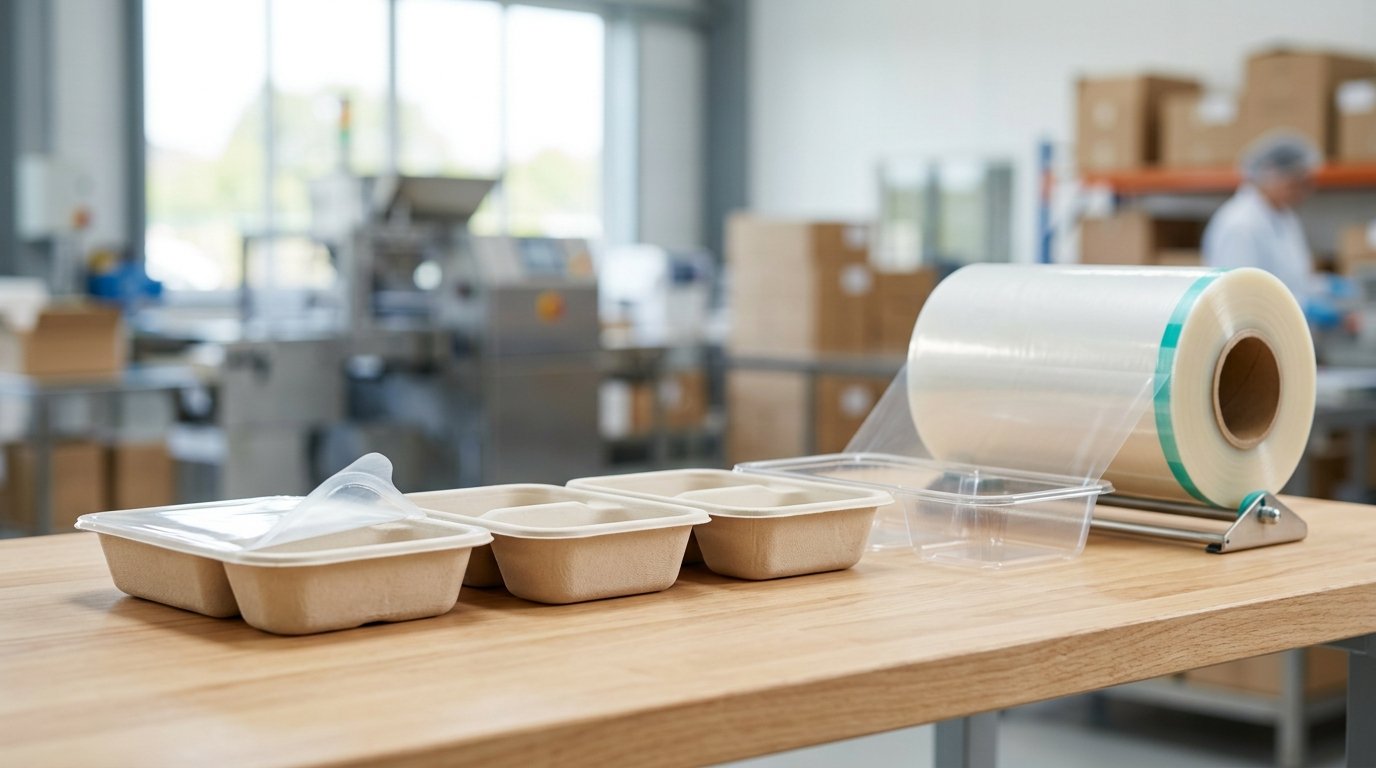
Quick answer: Cirkla, Belmark and Ossid have combined a moulded fibre tray, a peel-and-reseal lidding film and an automated sealer to make a resealable fibre pack for fresh protein, produce and ready meals. It drops onto existing tray sealers, the companies say, and is aimed at the same jobs CPET, rPET and mono-PP trays do today. The fibre format still depends on a liner or coating to keep oil and moisture out, and published barrier numbers are thin, so treat the launch as promising rather than proven at this stage.
A fibre tray that reseals like plastic
Cirkla, Belmark and Ossid have unveiled an integrated packaging solution combining high-performance fibre trays, resealable lidding film and automated sealing technology. The packaging system combines Cirkla’s moulded fibre trays with Belmark’s resealable lidding film and Ossid’s automated sealing technology, designed for applications including fresh protein, produce and ready meals.
The companies picked a busy fortnight to show it off. The solution is being showcased at The Global Produce and Floral Show in Orlando, Florida, from 14 to 16 October, followed by Pack Expo in Chicago, Illinois, from 18 to 21 October. That’s the two shows where meat, produce and prepared-food packaging buyers actually are this month, which tells you who the pitch is aimed at.
The line that will get procurement’s attention is the claim about capital spend. The trays are designed as a plug-and-play solution, with no capital investment or production-line modifications required, according to Cirkla. Cirkla says it runs manufacturing operations in India and the U.S., combining fibre moulding expertise with scale manufacturing to work with brands from product development through to commercial delivery. Its first U.S. manufacturing facility is set to start operating in Gainesville, Georgia, in the first quarter of 2027, so current U.S. supply is running ahead of its own dedicated plant.
The bonding problem nobody had solved
Resealable lidding on rigid plastic trays is old news. Resealable lidding on a fibre tray is not, and the reason is mechanical rather than commercial. The companies claim the solution is the first to bring resealable lidding film to fibre trays at commercial scale, addressing a longstanding technical challenge around bonding peel-and-reseal film to a fibre substrate without compromising the tray’s liner. Peel seals need a bond strong enough to hold under modified atmosphere, weak enough to open by hand, and repeatable over several open-reseal cycles, all without tearing the moisture barrier that keeps the board dry underneath. That’s a narrower process window on fibre than on a smooth plastic surface.
The sealing side of the system is a known quantity. Belmark supplies the lidding film, while sealing is handled via the ReeMaster NextGen Automatic Tray Sealer from Ossid, a ProMach business unit and the North American distributor for Reepack. Intended for medium to large-scale production, the unit employs servo-indexed conveyors and lateral clamps to align trays during processing, according to Cirkla. The system features a washdown-ready, stainless-steel open frame built for tool-free cleaning and maintenance, alongside a 12-inch colour touchscreen with digital recipe storage to accelerate changeovers among top-seal, modified atmosphere packaging and vacuum skin packaging formats. Running MAP, VSP and plain top-seal off one recipe-driven machine is standard practice for plastic trays; putting a fibre tray through the same three modes without a different sealer is the actual news here.
Cirkla’s own framing is confident. Glenn Divers, the company’s vice president of sales, said the partnership was built so brands could “remove every reason not to switch” from single-use plastic trays.
How much plastic actually comes out
The headline sustainability number has moved around a bit between launches, which is worth flagging. For this resealable version, Cirkla’s fibre trays are designed to provide performance comparable with plastic in areas including shelf life, barrier properties and durability, while reducing plastic waste by up to 90%. That’s up from the figure quoted for Cirkla’s earlier bagasse MAP tray launch: that January 2025 product was described as a high-performance alternative to traditional plastic MAP trays, reducing plastic content by around 85%. Neither figure comes with a published methodology, so treat both as company claims rather than third-party verified results.
On its own site, Cirkla lists broader credentials for its fibre range: up to 90% less plastic by weight, home and industrial compostability, curbside recyclability and PFAS-free status, with certification from bodies including TÜV Austria, BPI, How2Recycle and the FDA. For its meat trays specifically, the company’s own materials describe a two-step disposal routine: the liner peels off for the plastics bin while the tray itself goes in the paper stream, which is a step consumers have to get right for the recyclability claim to hold in practice.
Fibre trays against the rest of the field
Fibre isn’t the only answer to the “get plastic out of the tray” brief. CPET, rPET and mono-PP are all live alternatives, each solving a different part of the problem.
CPET trays are ovenable to high temperatures and freezer-safe, which has made them the incumbent material for premium frozen entrees and dual-ovenable applications. The sustainable move within that category is toward rPET trays with 50 to 90% post-consumer recycled content, which keep the same thermal performance and oven compatibility as virgin CPET while cutting the carbon footprint of the base material. Mono-PP is a separate lane again: Coveris has introduced a resealable monomaterial tray, MonoFlexBP, aimed at refrigerated food applications, intended to replace non-recyclable mixed-material packaging while keeping shelf life and consumer convenience. For higher barrier needs, Coveris pairs that tray with a PET- and PA-free lidding film that seals, peels and reseals on PP trays. That’s a resealable fix that stays entirely inside a single, widely-recycled plastic stream, without moving to fibre at all.
Fibre’s own ceiling depends heavily on which liner or coating sits on it, and that’s where published numbers start to diverge. Walki’s Pack Tray range, a PET-lined or PET-free fibre board for ovenable and microwaveable trays, is certified for use up to 220°C for 60 minutes. General bagasse and pulp trays are a different story: moulded fibre trays made from sugarcane bagasse or recycled paper pulp with PFAS-free moisture-resistant coatings typically handle microwave temperatures only up to around 200°F, or roughly 93°C, depending on the coating used. The gap between those two numbers is the gap between a board engineered for an oven brief and a bagasse tray engineered for a microwave brief, not a single “fibre” performance figure.
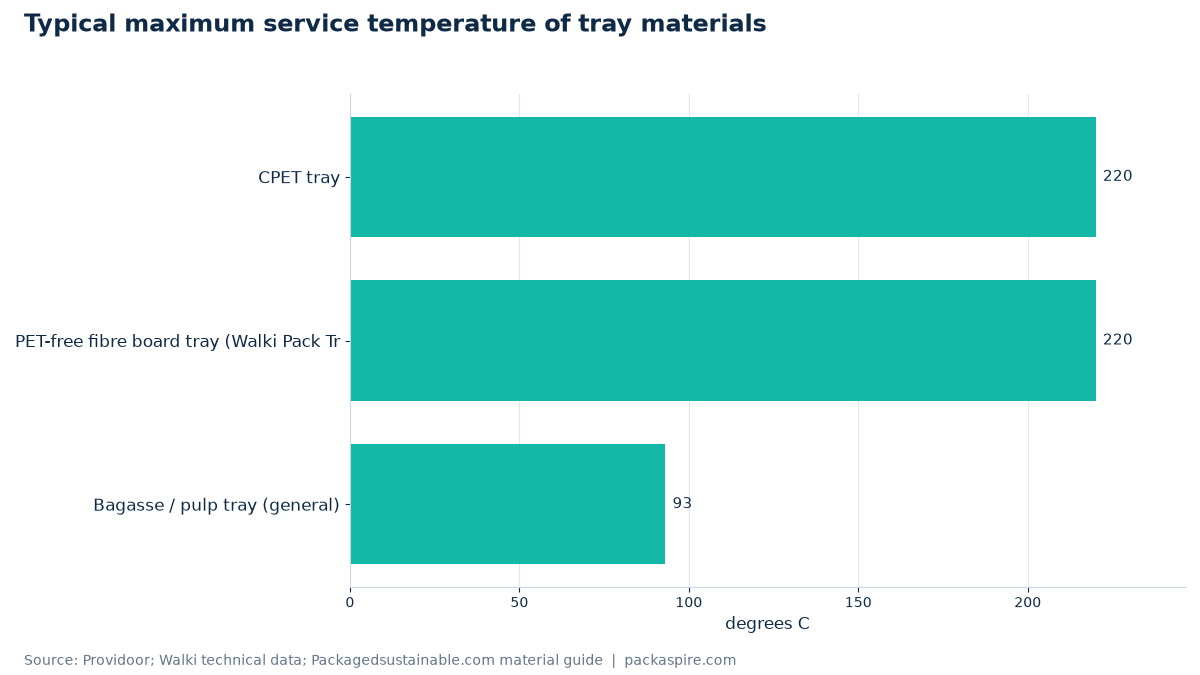
The carbon case for paperboard and fibre is the strongest part of the pitch so far. Paperboard trays with advanced barrier coatings, including nano-cellulose, bio-based polymer or seaweed-derived barriers, are reported to deliver carbon footprints roughly 60 to 70% lower than equivalent plastic trays when the coating stays compatible with paper mill repulping. But that comes with a hard limit: moulded fibre is not currently positioned as the right choice for conventional oven applications above around 200°F, nor for products where the crystal clarity of a plastic tray drives shelf appeal in premium frozen meals. Nobody’s own material does everything.
| Format | Core material | Resealable lid | Recycling route | Typical use |
|---|---|---|---|---|
| Fibre tray + peelable liner (Cirkla/Belmark/Ossid) | Moulded plant fibre with liner | Yes, peel-reseal film separate from tray | Tray to paper stream, liner to plastics bin, both separately | Fresh protein, produce, ready meals |
| CPET tray | Crystallised PET, often coextruded barrier | Peel lidding common, limited reseal history | PET stream where accepted clean | Frozen entrees, dual-ovenable meals |
| rPET tray | PET with 50-90% recycled content | Standard peel lidding | PET stream | Chilled ready meals replacing virgin CPET |
| Mono-PP tray (e.g. Coveris MonoFlexBP) | Polypropylene | Yes, PET/PA-free resealable lidding film | PP stream if lid separates cleanly | Refrigerated and chilled foods |
| Conventional coex barrier tray | PP or PET with EVOH and tie-layer adhesive | Usually weld seal, little reseal | Often rejected: barrier layer can dilute the substrate below the 95% purity recyclers need | Legacy MAP trays still in wide use |
The recycling stream still decides the outcome
A tray claiming recyclability on a brand’s packaging guide and a tray that actually gets accepted and sorted at a materials recovery facility are two different things. Patent filings on barrier tray design spell out why conventional structures so often fail that second test: oxygen-barrier layers and their adhesive tie-layers need to stay under a tight threshold or the whole tray gets rejected from the plastics stream it was labelled for, because the barrier resin and adhesive dilute the main substrate below the purity recyclers require. A tray that’s 90% PP with 10% EVOH and 6% adhesive by weight ends up too mixed to count as recyclable PP, even though PP is the majority material. That’s the structural reason mono-material and fibre-based formats keep getting pitched as the fix: separating the barrier function from the main substrate, rather than blending it in, is what actually restores a clean recycling stream. Plastic MAP trays aimed at recyclability, such as Sealed Air’s Cryovac PP tray, are built predominately from PP identified as RIC-5 and may be recyclable depending on local collection.
Fibre has its own regulatory wrinkle coming. Moulded fibre and paperboard food contact packaging has historically leaned on fluorinated coatings for grease resistance, and that’s now under direct restriction in the EU: the EU’s Packaging and Packaging Waste Regulation bans the intentional use of PFAS in food-contact packaging starting 12 August 2026. Several U.S. states have moved earlier and on different thresholds. None of this is settled everywhere at once, so check the current legal text and your own test results rather than a supplier’s compostability certificate alone; ppwreu.org is a reasonable starting point for the EU detail.
Where this actually fits on shelf
Resealability matters most where the pack is opened more than once before the contents are gone: multi-portion produce, sliced protein, family-size ready meals. Resealable functionality has traditionally belonged to rigid plastic packaging because bonding a resealable film to a fibre substrate without weakening the liner was the unsolved part of the problem, which is exactly why categories like fresh-cut produce and deli protein have stayed on plastic trays even as plastic reduction targets have tightened elsewhere in the pack. If the bonding genuinely holds up through repeated opening in the field, and not just on a trade show floor, fibre becomes viable for a wider slice of chilled and ready-meal formats than it has been so far.
What’s still missing from the public record is a published oxygen transmission rate or water vapour transmission rate for the fibre tray itself, tested to a named method such as ASTM D3985 or ASTM F1249. Every comparison in this piece rests on supplier claims of “comparable with plastic” rather than a disclosed number, which is normal for a product this new but worth asking your supplier for directly before specifying it against a product with a known shelf-life requirement.
What this means for you
- R&D and quality teams: ask any fibre tray supplier for OTR and WVTR figures at stated temperature and humidity, tested to a named method, before you compare shelf life against your current CPET or PP tray. A “comparable to plastic” claim without numbers isn’t a specification.
- Procurement: plug-and-play claims are about sealer compatibility, not price. Ask for a landed cost per thousand units against your current tray and run it through your own numbers; the pack cost calculator is a quick way to compare cost per 1,000 packs once you have supplier quotes.
- Sustainability and packaging design: a recyclability claim only holds if the consumer actually separates liner from tray. Build that instruction into on-pack graphics from day one rather than retrofitting it after a launch.
- Anyone specifying a barrier stack: if you’re weighing a coated fibre board against a coextruded plastic structure, the laminate estimator gives an indicative weight and barrier comparison across layer options, and the material properties table is a useful baseline for typical values by material.
- PPWR and PFAS compliance: treat supplier PFAS-free claims as a starting point for your own total organic fluorine testing, not the end of due diligence, especially for anything crossing into the EU after August 2026.
Sources
- FoodBev Media: Cirkla, Belmark and Ossid unveil resealable fibre tray packaging solution
- Packaging Gateway: Cirkla, Belmark, and Ossid introduce resealable fibre food trays
- Packaging Strategies: Cirkla, Belmark and Ossid Launch Resealable Fiber Tray Packaging
- PR Newswire: Cirkla, Belmark, and Ossid Unite to Launch the World’s First Resealable Fiber Tray Packaging Solution
- ADVFN: Cirkla, Belmark, and Ossid Unite to Launch the World’s First Resealable Fiber Tray Packaging Solution
- Cirkla: High Barrier Fiber Trays
- Cirkla: News & Events
- Yahoo Finance / PR Newswire: Cirkla Launches World’s First Fiber MAP Trays
- Packaging Strategies: Coveris Introduces Monomaterial Resealable Tray Solution for Refrigerated Foods
- Walki: Walki Pack Tray
- PackagedSustainable: Sustainable Food Trays: Materials and Suppliers for Frozen and Ready Meals
- Sealed Air: Cryovac Polypropylene (PP) Tray for MAP
- Providoor: Can You Put a CPET Tray in the Oven?
- Isurusworks: PFAS Food Packaging Ban EU 2026