
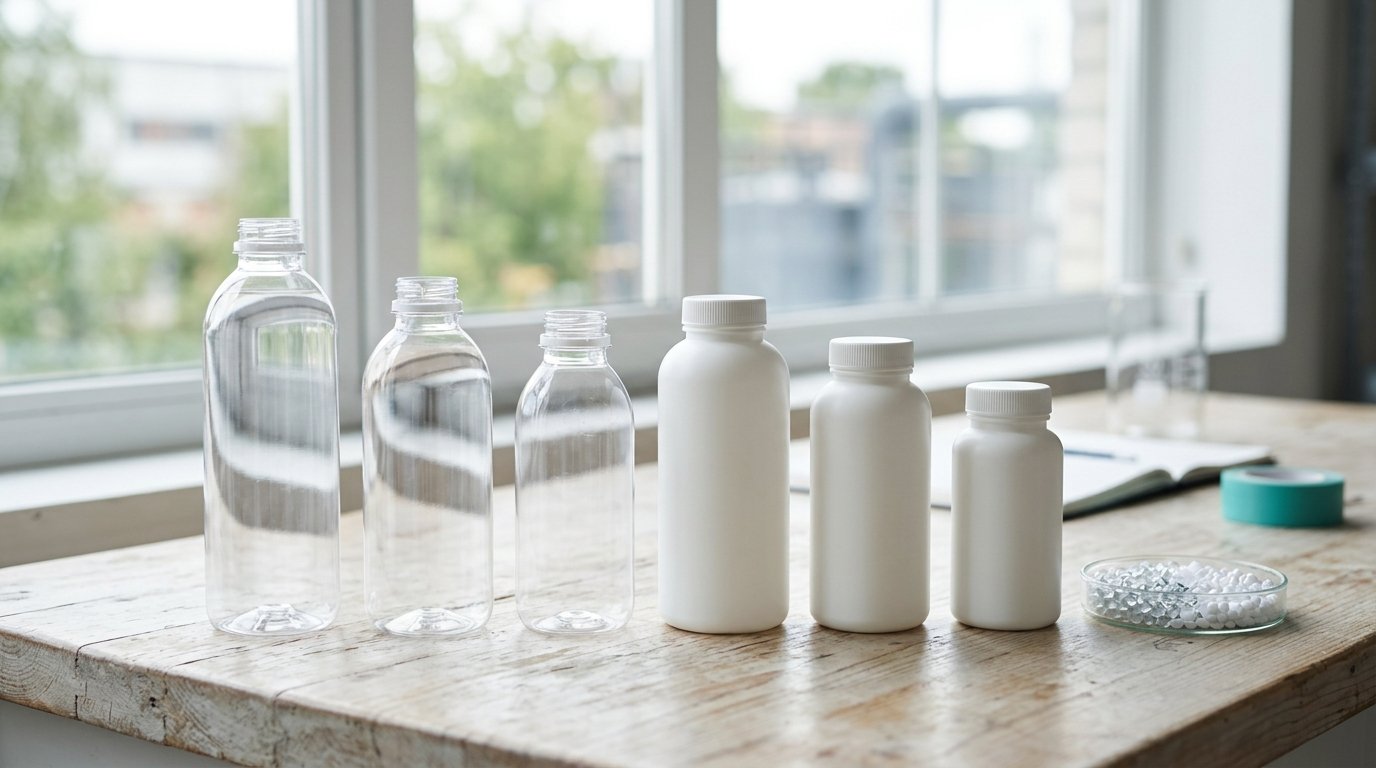
Quick answer: Treat rPET, rHDPE and rPP as three separate sourcing problems. rPET has the deepest supply but a stubborn premium over virgin, rHDPE is the most exposed to bale swings, and food-grade rPP is the hardest to buy at volume. Specify by application and colour first, then check the spread to virgin with your supplier.
The trigger is a 26 October 2026 PlasticsToday report on recycled plastics, built on ICIS analysis, which describes uneven October trends across rPET, rPE and rPP. It sits on top of a year of mixed signals from ICIS, S&P Global Platts and Argus. This article sticks to the rigid-pack resins and leaves film out.
Three resins, three different October stories
In the 26 October PlasticsToday piece, ICIS analyst Corbin Olson said US rPET bale markets are well supplied. Recycler closures limit domestic demand, and exports absorb the surplus. She added that domestic flake keeps a cost advantage over imports because freight and logistics costs keep delivered import values high.
Pellet pricing held steady even as flake costs rose, according to the same report. That squeeze matters to anyone buying food-grade pellet: the converter’s margin sits between a rising input and a pellet price that buyers won’t move. The report also notes that end-use consumption remained sluggish heading into the fourth quarter.
The polyolefins have had a rougher ride. ICIS senior editor Craig Fisher reported in June 2026 that US natural HDPE bale prices fell nearly 40% from their mid-May highs, as import arrivals rose and buying slowed. Demand was still supported by brand-owner post-consumer recycled (PCR) commitments, he said, but buyers had gone to a wait-and-see approach.
Recycled PP looks different again. Fisher reported in May 2026 that feedstock for food-grade streams stayed constrained, with limited FDA-approved capacity restricting output. In February he put the rPP price premium to virgin at around 2.5 times, which he said gives virgin a strong cost position while PCR targets stay fluid. By August, food-grade rPP was about 15% above year-ago levels, per PlasticsToday’s 26 August report.
All of this is US reporting. European assessments follow their own curve, and the two shouldn’t be read across without checking the region, grade and delivery basis.
The spread to virgin is the number to watch
An absolute recyclate price tells you little without the virgin price next to it. The spread decides whether a brand keeps or drops recycled content when budgets tighten. ICIS senior editor Matt Tudball, quoted in Packaging Europe, noted that a spread near EUR 590 per tonne between European food-grade rPET pellet and virgin bottle-grade PET was leading some small and mid-sized brands to cut back in early 2025.
Argus reported a similar shape for 2025: the food-grade pellet premium over virgin PET peaked at EUR 700 per tonne and stood at EUR 585 per tonne at the time of writing. Argus also observed that national plastic taxes on virgin material, such as Spain’s EUR 450 per tonne and the UK’s rate of just over GBP 220 per tonne, hadn’t been enough to hold rPET volumes against a switch to virgin.
S&P Global Platts gives the clearest regional picture. Its 2025 assessments of the food-grade rPET pellet premium to virgin peaked at different times in each region, and all three ended the year well above where they started or, in the US, lower.
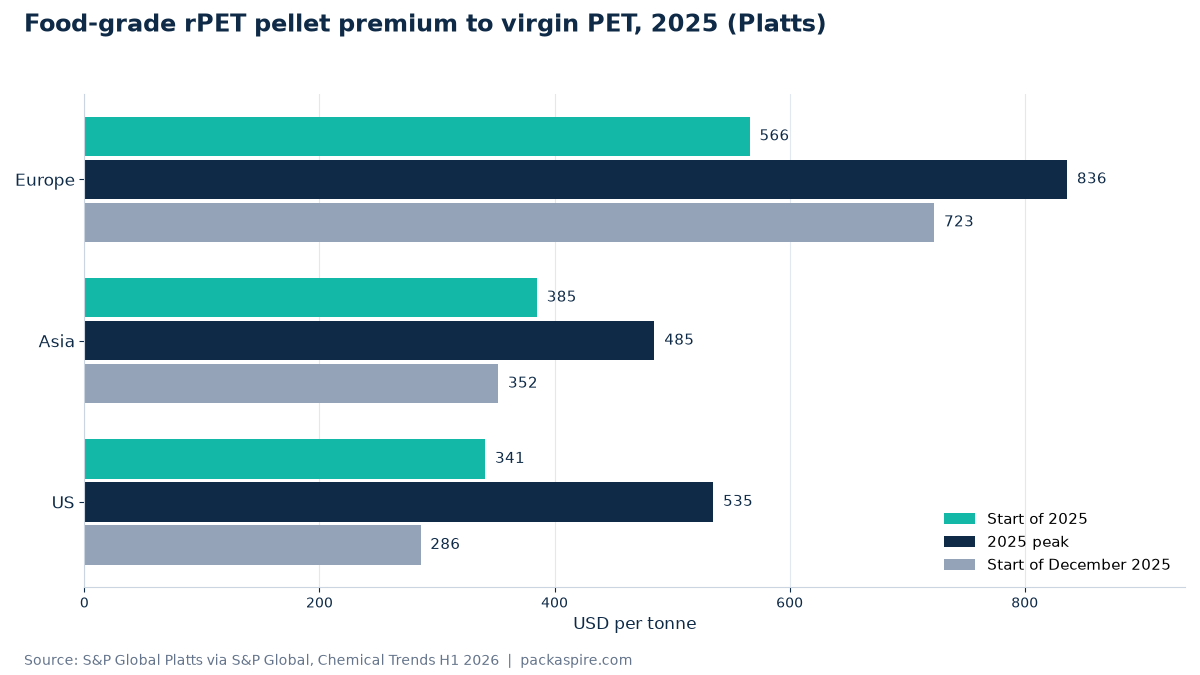
Platts attributes the weak spot in Asia to a lack of mandates, which leaves demand reliant on voluntary brand commitments. In Europe, the report points to unclear enforcement as the drag.
The EU’s Packaging and Packaging Waste Regulation (PPWR) sets recycled content targets for plastic packaging, with 2030 the first date trade press cites; check the current text and the detail at ppwreu.org. One trade site, european-recycling.com, argues the obligation is still mostly prospective demand, which fits the soft pricing it reports for mid-2026.
Colour matters more than the polymer label
The same site’s August 2026 analysis, built on OPIS assessments, argues that most of the gap between rPET, rHDPE and rPP prices comes down to colour rather than polymer. It puts a value of around EUR 600 per tonne on colour in its June 2026 curve. Treat that as one trade site’s reading of one assessment, not a rule.
The practical point stands. Natural HDPE and clear PET sit at the top of each resin’s range because they can go back into the widest set of packs. Pigmented or mixed-colour streams are cheaper because fewer applications accept them. The same site reports white rHDPE pellets trading below natural.
Typical properties and recyclate notes
The table puts the three resins side by side. Density and melting points are typical ranges from a supplier’s resin comparison and from Laird Plastics’ HDPE guide, which lists HDPE density to ASTM D792 and melting point to ASTM D3418. The barrier ratings are qualitative and come from the supplier comparison, which gives no test conditions. They are fine for orientation and useless for design.
| Resin | Density (g/cm3) | Melting point (°C) | Barrier, qualitative | Recyclate note |
|---|---|---|---|---|
| PET | 1.33 to 1.39 | about 260 | Good oxygen; good moisture | Food-grade pellet is the premium grade; premium to virgin is the sticking point |
| HDPE | 0.94 to 0.97 | 120 to 130 | Poor oxygen; excellent moisture | Natural stream most sought after; bale prices swing |
| PP | 0.90 to 0.91 | about 160 | Poor oxygen; excellent moisture | Food-grade supply tight; limited approved capacity in the US |
Typical values only. Grades vary with molecular weight, copolymer content, additives and processing, and the supplier data sheet decides. For a broader table of materials, see our material properties page.
One spec example shows how tight food-grade PET pellet can be. When S&P Global Platts launched its US rPET food-grade pellet assessment, it defined the reference material as intrinsic viscosity between 0.76 and 0.82, PVC no higher than 10 ppm and acetaldehyde no higher than 1 ppm. Your own spec may differ, but a pellet buyer will be asking these questions.
Best for: matching resin to pack
Best for clear beverage bottles and thermoformed trays: rPET. It has the deepest supply chain and the most established food-contact route. The cost is the spread to virgin, which is the figure to run through the pack cost calculator with your own supplier quotes.
Best for opaque milk, juice and home care bottles: rHDPE. Brand PCR commitments keep demand supported, according to ICIS, but the bale market has shown how fast prices can move. A contract that indexes to a published reference gives more protection than a fixed spot quote.
Best for closures, tubs and caps where a moisture barrier is enough: rPP. Ask early whether your food-contact grade exists at the volume you need, because ICIS reported limited approved capacity in the US. If the pack is coloured or opaque anyway, a cheaper grey or black stream may cover non-food lines.
Best for cutting recycled content risk: lightweighting. Fewer grams per pack reduce exposure to any resin price, virgin or recycled. The lightweighting calculator shows the material saved per pack for a given weight change.
Reuse is the other lever: the stainless capsule example
Not every rigid-pack answer involves resin. Packaging Europe reported on 26 October 2026 that Caps’Me has developed a reusable stainless steel coffee capsule for Nespresso Original, Nescafé Dolce Gusto and Senseo machines, designed for over 1,000 reuses. A patented shaker system is said to refill it in a few seconds.
The company claims that over 100 million capsules have already been reused and that the product is sold at over 1,500 locations in France. Packaging Europe also relays the claim that one capsule replaces more than 1,000 single-use alternatives and generates over 8 times less waste. Those are the company’s statements; the report doesn’t publish the method behind the waste figure.
The sourcing logic differs from recycled plastic. A steel capsule has no food-grade recyclate bottleneck or spread to virgin; the exposure is the number of cycles it actually survives, and who washes it. If a team wants to benchmark a reuse claim, the useful questions are cycle-count test data, cleaning method and the system boundary of any life cycle assessment.
What this means for you
- Procurement: ask suppliers for the spread to virgin on your specific grade and colour, in writing, with the index and date. A recyclate price without that reference is half a number. Ask your supplier for a quote rather than relying on trade-press figures.
- Packaging engineers: request the data sheet for each recyclate grade, including intrinsic viscosity for rPET or melt flow for polyolefins, and compare it with your virgin baseline. Grade-to-grade variation is larger than the differences in the table above.
- Brand and sustainability teams: expect recycled content to be tested in the next budget round if the spread widens. Colour choices, such as allowing natural or white versus a tinted bottle, change what you can buy.
- Quality teams: food-contact status of a recyclate is a regulatory question for your own regulatory team and the authority in each market. Confirm it before a spec is frozen.
- Students: the useful exercise is plotting a recyclate price against its virgin reference over time. The unit converter helps when sources mix per-tonne and per-pound quotes.
Sources
- PlasticsToday: Recycled Plastics Markets Show Mixed October Signals (26 October 2026)
- PlasticsToday: Recycled Resin Prices Decline as Supply Improves (June 2026)
- PlasticsToday: Recycled Resin Prices Shift as Markets Adapt in May
- PlasticsToday: Recycled Resin Markets, PET Bale Prices Decline as Major US Recyclers Shutter Plants
- PlasticsToday: Summer Surge Sends Recycled Resin Prices Into Freefall (26 August 2026)
- S&P Global: Recycled Polymers, Chemical Trends H1 2026
- Recycling Today: S&P Global Platts launches US rPET pellet assessment
- Argus: Recycled Polymers 2025
- Packaging Europe: Why are some brands focusing on cost over circularity?
- european-recycling.com: rPET, rHDPE and rPP, which recyclate goes where
- european-recycling.com: Recyclate prices June 2026
- Laiyang Packaging: Plastic Resin Properties Comparison HDPE vs PET vs PP vs LDPE
- Laird Plastics: HDPE Guide
- Packaging Europe: Refillable stainless steel coffee capsule aims for 1,000+ reuse cycles
- PPWR EU: regulation detail
Values are typical figures from the cited sources. Grades differ between suppliers. Check the supplier's data sheet and test your own structure before you decide.